
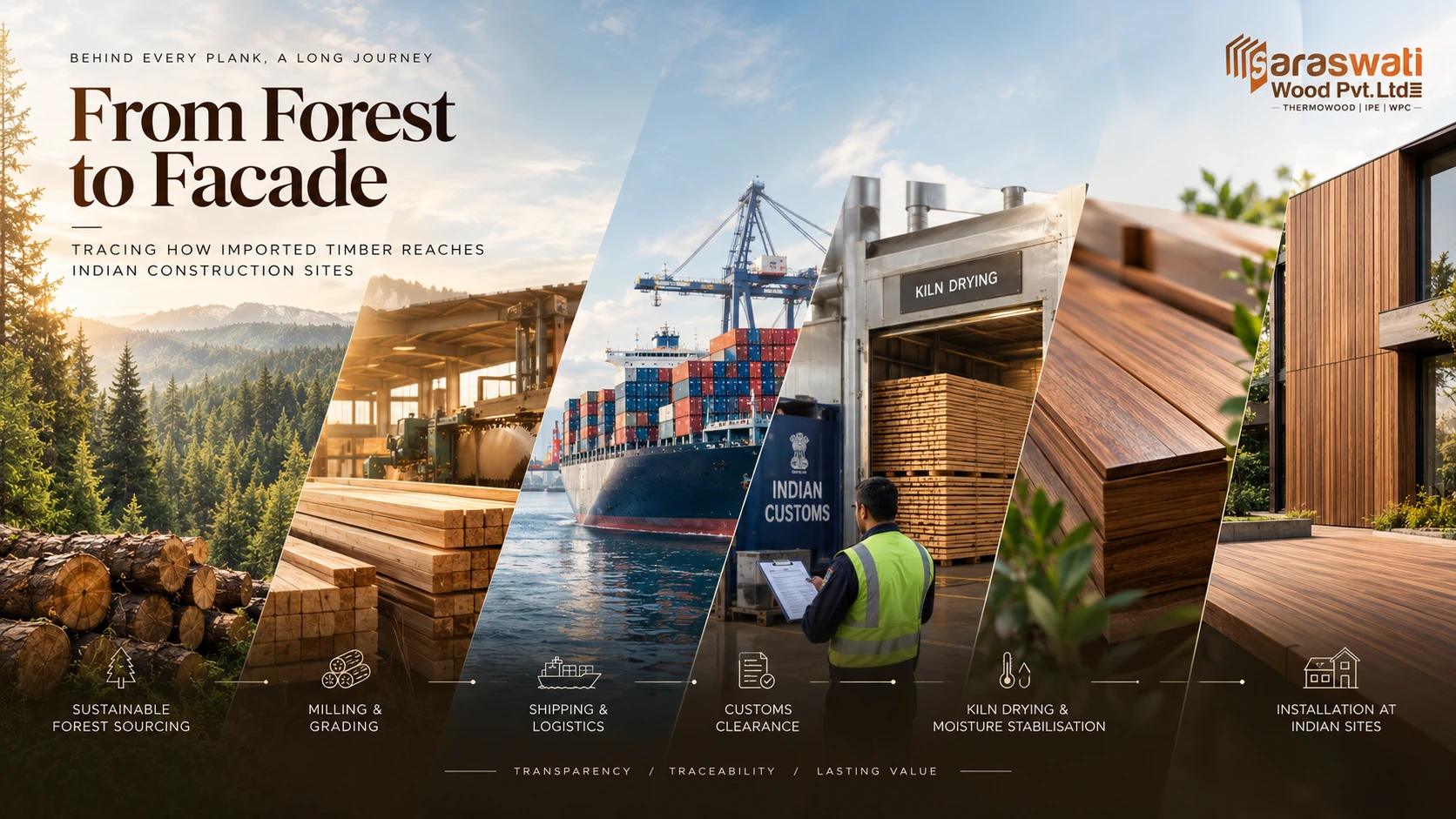
From Forest to Facade: Tracing How Imported Timber Reaches Indian Construction Sites
When an architect specifies imported hardwood or thermally modified timber for a project, what arrives on site is the end point of a supply chain most people in construction never see. Understanding that chain isn't just interesting background, it's practical information, because where and how timber is sourced directly affects its quality, its sustainability credentials, and how reliably it performs once it's installed.
The journey begins in forests where timber is harvested under managed forestry programmes. Reputable sourcing means the harvest rate doesn't exceed the growth rate of the forest, a standard tracked and certified by bodies whose documentation should be traceable back to the specific batch of timber, not just the species in general.
Once harvested, logs are milled into rough lumber at facilities local to the forest source. This is typically where species-specific characteristics are first graded and sorted, separating boards by quality, grain consistency, and dimension before they're prepared for export. From the mill, timber is containerised and shipped, a journey that can take several weeks depending on origin.
On arrival in India, shipments go through customs clearance, which includes verification of species documentation, quantity, and compliance with import regulations. This is a stage where supply chain transparency matters enormously, since improperly documented shipments face delays that ultimately affect project timelines on the Indian end. This is arguably the most important step for anyone specifying the timber, and the one least visible to buyers.
Once timber reaches an Indian facility, it needs to be kiln dried and moisture-stabilized for Indian conditions specifically, not simply for the climate it was harvested in. A board that was correctly dried for a European or North American climate can still warp or crack in Indian humidity if it isn't re-stabilized on this end of the journey.
The final stage is where raw imported timber becomes the decking, cladding, or flooring product that reaches an architect's spec sheet, milled to profile, finished, and distributed to suppliers and construction sites across the country.
Every one of these steps is an opportunity for quality to either hold or slip. A supplier with visibility and control across the full chain, sourcing, documentation, shipping, and final kiln drying, is in a fundamentally different position from one simply reselling timber that's changed hands multiple times before reaching them. For a material that's expected to perform outdoors for decades, that difference shows up eventually, whether in the warranty conversation or in the wood itself.
Saraswati Wood Private Limited has operated as an established importer, trader, supplier, and manufacturer since 1997, giving us direct visibility across this chain, from sourcing to final kiln drying, for our Thermowood, IPE wood, and wooden flooring ranges. For architects and builders, working with a supplier who controls that journey end to end is one of the simplest ways to reduce risk on a project that depends on the timber performing exactly as specified.