
The Kiln Drying Process Explained: Why Moisture Control Determines Timber Lifespan
A tree, freshly felled, can be over 50% water by weight. Left untouched, that moisture doesn't leave evenly, it escapes unevenly from the surface inward, and as it does, the wood shrinks, twists, and cracks along the way. This is the single most common cause of timber failure on Indian construction sites, and it has nothing to do with the quality of the species. It has everything to do with what happens or doesn't happen before the timber ever reaches site.
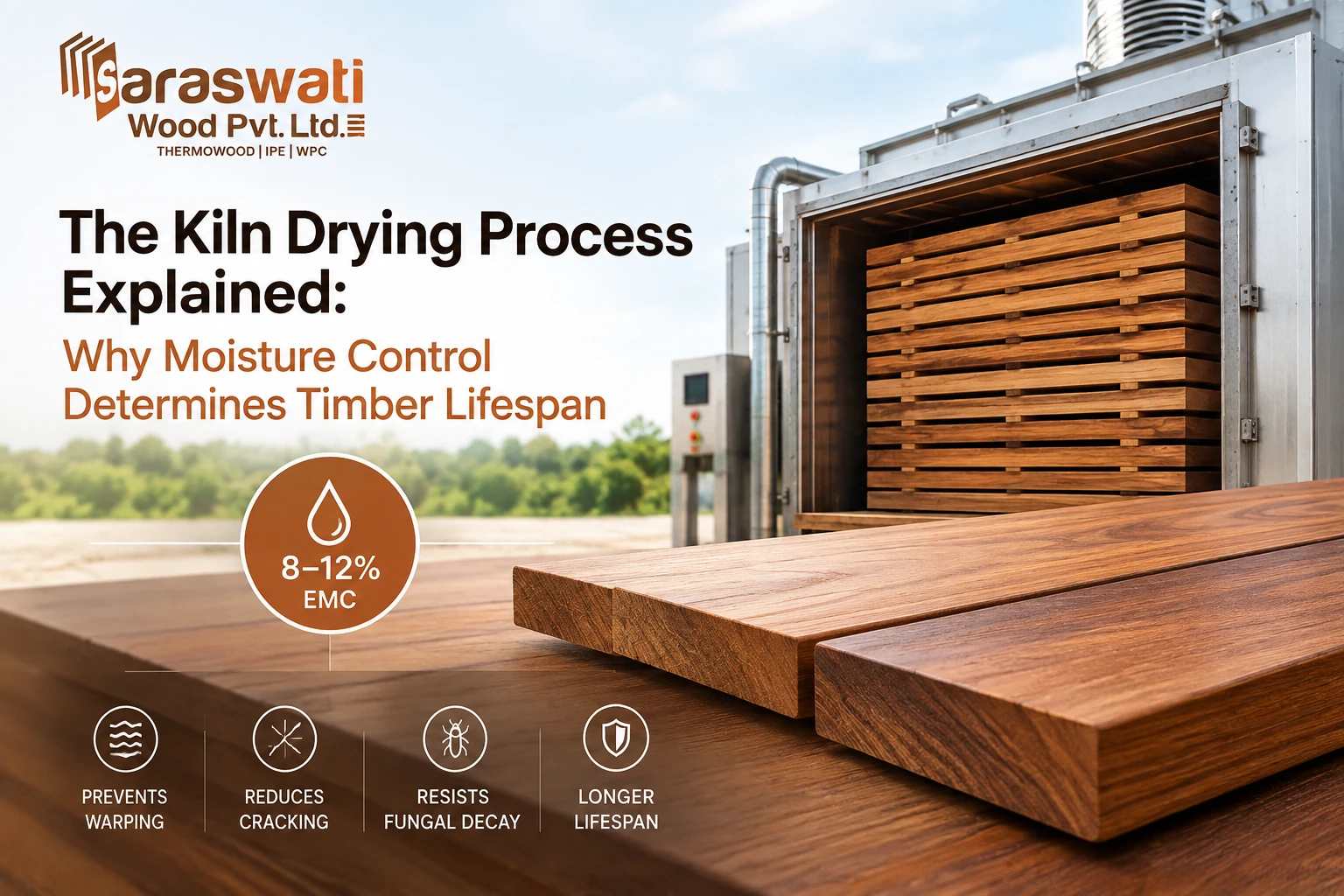
Kiln drying process is a controlled process of heating timber inside a sealed chamber to systematically reduce its internal moisture content to a target level, typically between 8-12% for construction applications, before the wood is milled or installed. It's the same standard we hold every product to at Saraswati Wood: our Thermowood range, IPE wood decking, and cladding are all kiln dried and moisture-stabilized before they leave us, not after a problem shows up on site.
This is also where seasoned wood vs kiln dried wood stops being a marketing distinction and becomes a practical one. Air drying depends entirely on ambient weather and can take months or years to reach a fraction of the same result. Kiln drying manages temperature, humidity, and airflow together, pulling moisture out from the core of the board as evenly as from the surface, which is why kiln dried timber suppliers in India who control this step in-house produce a fundamentally more predictable, moisture resistant timber than one dried casually or not at all.
Every wood species has an equilibrium moisture content, or EMC, the point at which the timber's internal moisture stops changing because it has balanced out with the humidity of its surroundings. In a coastal Indian city with high year-round humidity, that equilibrium point is very different from a drier interior region. Timber that hasn't been dried to the correct target before installation keeps trying to reach its EMC after it's already been fixed into a deck, cladding panel, or floor, expanding and contracting with every seasonal humidity swing. That constant movement is what shows up months later as cupped boards, gapped flooring, or cracked cladding joints. None of these are defects of the species itself, they're consequences of moisture that was never properly managed before installation.
India's climate compounds the problem. Monsoon humidity, coastal salt air, and dry summer heat create some of the widest seasonal moisture swings any timber will face globally. Timber that's correctly kiln dried and stabilized before it leaves the supplier is engineered to handle that swing with minimal movement; timber that isn't will show it within a single season, regardless of how premium the species is on paper. This is why kiln drying isn't just a step before thermal modification for products like Thermowood or before profiling hardwoods for decking, it's the foundation every other durability claim rests on.
At Saraswati Wood Private Limited, every batch of timber, from our Thermowood range to our IPE wood decking and cladding, is kiln dried and moisture-stabilized before it reaches architects and builders, so the durability promised on the spec sheet is the durability that actually shows up on site, years down the line.