
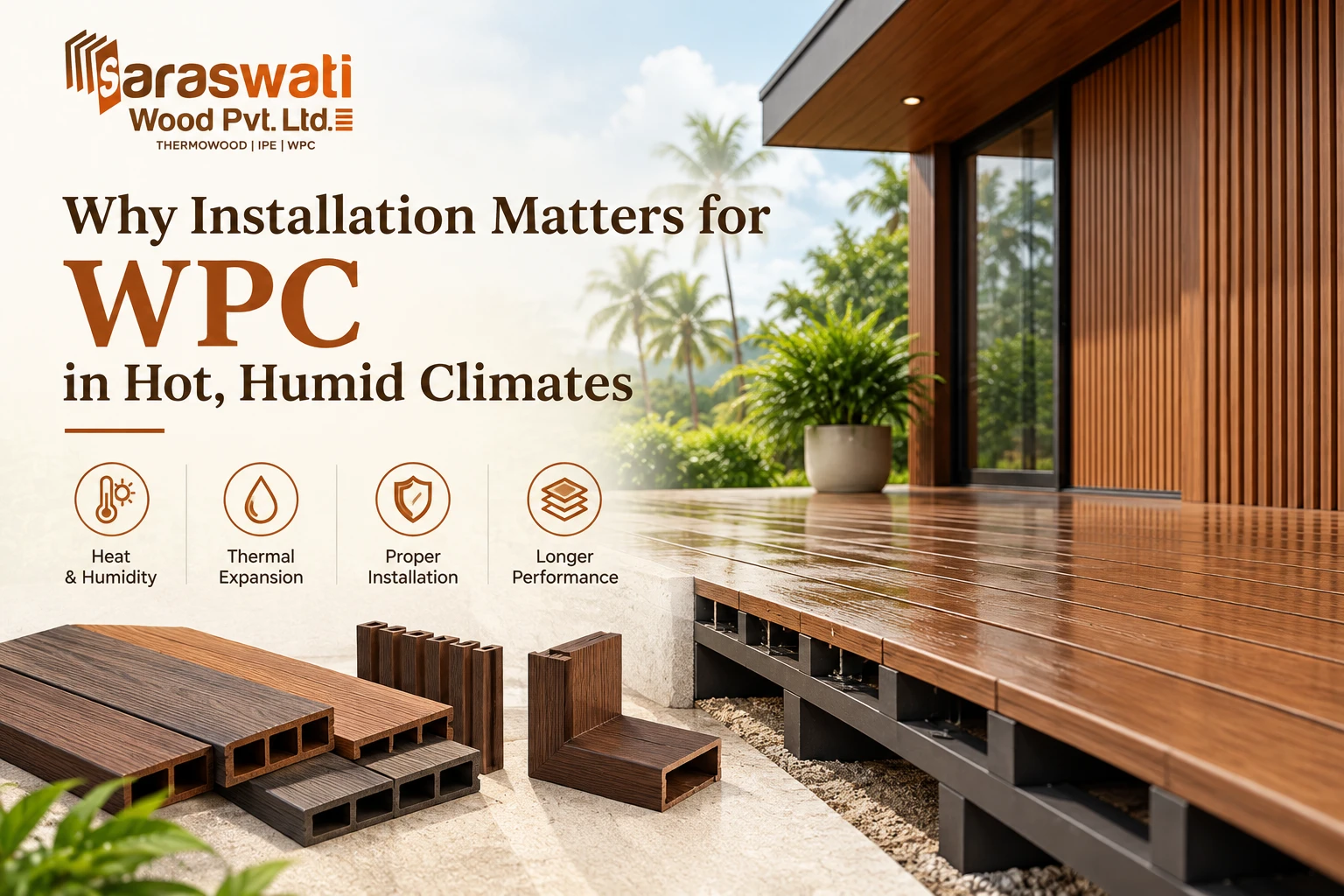
Why WPC Installation Matters In Hot, Humid Climates
Wood Plastic Composites, also known as WPC, have created a striking place in the building material industry. In India, the WPC market reached approximately USD 290.5 million in 2025, with building and construction accounting for the largest share of demand. This rapid growth in the market is because of India's varied climate, where heat, humidity and monsoon rainfall cause damaging conditions on exterior materials. WPC offers similar wood like finish, while combining it with the performance characteristics of a composite material, making it an ideal option for exterior applications. However choosing the write kind of WPC profile is the beginning, how it is installed plays an equally important role in achieving high performance, especially in hot and humid climates.
WPC is increasingly being used across demanding exterior applications such as decking, outdoor cladding and louvers, where material performance and installation go hand in hand. In Indian climate factors such as temperature variation and moisture exposure make installation particularly important. The methods of WPC fixing, spaced and finished can influence how the system accommodates thermal movement and performs over time.
Saraswati Wood offers a range of WPC solutions for these applications, including WPC Decking, WPC Louvers and L-Corner Profiles. Understanding the requirements of each product and application is therefore an important part of planning a WPC installation.
Why Climate Matters During Installation
Hot and humid climates expose WPC to a combination of high temperatures, humidity, rainfall and prolonged sunlight, all of which need to be considered during installation. Temperature fluctuations can cause WPC profiles to expand and contract, making WPC thermal expansion an important part of installation planning. Other than changing temperature moisture exposure, drainage and airflow need to be addressed through appropriate spacing and detailing while installation. This is why WPC installation in hot and humid climates requires more than simply fixing the boards in place; it requires proper installation to ensure the material performs as intended under these conditions.
An outside installation should be made with the attention to how water moves and where it is exposed. How the boards, shapes, joins and supporting parts are put together can change how the whole system deals with changing weather. This is especially important when planning installation in hot and humid climates, where high temperatures, humidity and rain, from the seasons can all happen at the same time.
Allowing For Expansion
One of the key principles in the WPC installation guide is to let materials move. WPC expansion gaps give space for size changes that happen when temperature changes. If movement is ignored during installation, boards or profiles can suffer stress when temperatures shift. The right amount of space depends on the product, the installation system and the environment. Therefore installers must always follow the manufacturer’s recommendations. Not use a single rule for every case.
For architects and contractors this difference is key, between fixing boards and carefully planning a WPC system.
Installation Across Different Applications
The installation approach for WPC depends on the application because interior and exterior applications have different exposure conditions, orientations and functional requirements, which makes an application-specific installation approach non-negotiable.
WPC Decking is used for outdoor applications such as patios, balconies, pool surrounds and garden walkways. Since the boards form a horizontal surface exposed to outside weather and high footfall, elements like supporting structure, fixing system, board spacing and allowance for thermal movement need to be considered during installation.
WPC Exterior Cladding requires specific attention to alignment, fixing and movement across the surface. With larger wall areas, consistent spacing and appropriate detailing become important for accommodating thermal extraction and maintaining a uniform finished appearance.
WPC Louvers are used across different interior and exterior applications including facades, walls, ceilings, partitions and pergolas. Precise fixing and alignment are particularly important here because the spacing and repetition of the louvers form a visible pattern which adds architectural depth to that space.
WPC L-Corner Profiles are used to finish and protect exposed corners and edges of WPC installations. Selecting the appropriate profile and integrating it correctly with the adjoining surfaces helps create a cleaner, more complete finish.
To ensure the intended long-term performance, the key is to follow a suitable installation approach for the specific WPC product rather than applying the same approach across every application.
The Role Of The L-Corner Profile
Finishing details can have an important role in the appearance of a completed WPC installation. The WPC L-Corner Profile can be used around exposed corners, edges and joints to provide a finished transition between surfaces. Saraswati Wood offers L-Corner Profiles in finishes including Burma Teak, IPE Wood, Deep Wood and Silver Oak. Selecting a compatible profile helps maintain visual continuity between the main WPC surface and its finishing details.
Common WPC Installation Mistakes
Several installation issues can be avoided through careful planning. Common WPC installation mistakes include failing to account for thermal movement, using an unsuitable fixing approach, overlooking product-specific installation requirements and treating every WPC application in exactly the same way.
The local environment should also be considered. For projects using WPC for Indian climate conditions, designers and installers may need to account for high temperatures, humidity, monsoon rainfall and seasonal changes when planning the installation.
The Right Installation Starts With The Right Planning
WPC can be used in different types of building designs but it is important to know the material, the system it comes in and the place where it will be used. Heat changes, space for expansion, how it is fixed, the support it needs and the final touches all have to be thought about before starting to install. For WPC Decking Installation in India as well as, for cladding and louvers good planning can make the final result look better and be more complete.
Saraswati Wood offers WPC solutions including WPC Decking, WPC Exterior Cladding, WPC Louvers and L-Corner Profiles. Explore Saraswati Wood to understand its range of timber and architectural material solutions for your next project.